

On a recent trip to Jerusalem, I got an unexpected and fascinating tour of a facility just steps away from the Dome of the Rock that is dedicated to restoring old Islamic documents. My host was my new friend Mouhannad, whose family was graciously assisting me with my research and who works as a document restorer in the beautiful facility on the Haram al-Sharif (what Jews and Westerners call the Temple Mount).


As a former architect, the restored building that housed the facility was a treat all by itself. It is a glorious two-story Mamluk-era structure sited on the inner western enclosure of the Haram. The structure was the al-Ashrafiya madrasa, or school, which according to the Arabic inscription at its entrance was built in 1482 CE by the sultan Abu An-Nasir Qaytbay. Its beautiful entrance is characterized by alternating red and biege stone bands, a common Islamic style known as ablaq. I was amazed at the intricated interlocking stone details above the lintel and on the sides of the entry.

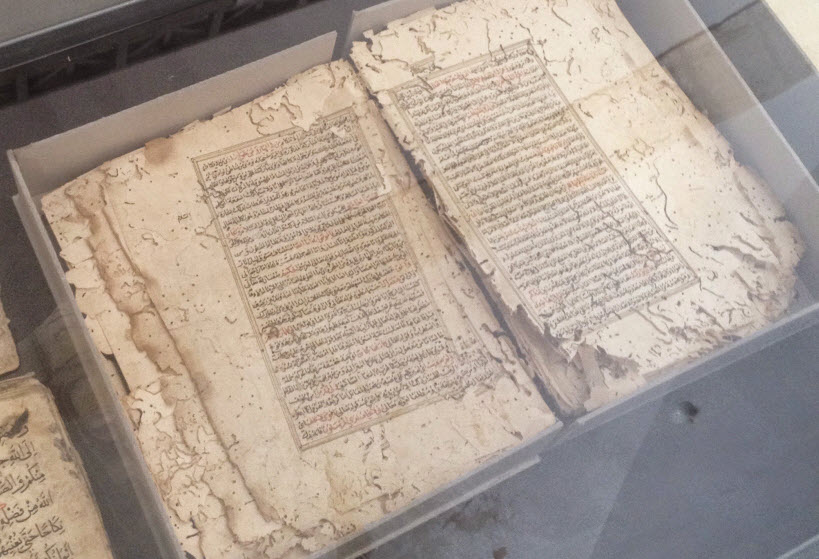
The restoration facility takes up the ground floor of the building, and on the second floor remains a small girl’s madrasa. The most interesting work involves the restoration of old Qurans. Many of the books are literally worm-eaten and otherwise infested with bugs. These books are bagged in nitrogen to deprive the organisms of oxygen and then held for several months until free of infestation.The restoration facility takes up the ground floor of the building, and on the second floor remains a small girl’s madrasa. The most interesting work involves the restoration of old Qurans. Many of the books are literally worm-eaten and otherwise infested with bugs. These books are bagged in nitrogen to deprive the organisms of oxygen and then held for several months until free of infestation.


The restored books are beautiful to behold. I was amazed at the draftsmanship of the lines and the use of gold ink.
Far less old but equally evocative for me were the many beautiful 4-colored printed maps the facility was restoring. This map of the Ottoman Empire was printed in Berlin in 1911, and still contained an entity called Mesopotamia…

Inside the facility, technicians were hard at work on restoration projects, mostly Qurans. The restoration of the building and the training of staff for the facility was a project of the Jordanian waqf or charitable trust that administers all of al Haram al-Sharif, in collaboration with UNESCO, and the staff are now waqf employees. A core group of restorers trained in Italy for three years and returned to form the nucleus of the technical group at al-Ashrafiya.


The technicians have to step over history at their jobs in a way that is difficult for us to imagine. In the “back rooms” (i.e. the structures that were built adjacent to, but outside of the Haram al-Sharif) the technical equipment had to be installed around the sarcophagi of the school’s founder and his wife and daughters, who died together in a 15th-century plague. The two little girls share the tiny sarcophogus in the middle between their parents.
When the restorers take a coffee break, they share the break room with the original Byzantine builder of the house. That’s Mouhannad with the original occupant, who lived there in the 5th century CE! That’s the guy’s hat (the dead Byzantine’s, not Mouhannad’s). It is made of tightly-wound cotton gauze fashioned into a kind of helmet.
